Players
For 2 to 5 players.
2–5 players · ages 14+ · approx. 60–90 minutes
Discover the gameWelcome to the island world
Thamylos is a strategy game for 2 to 5 players aged 14 and up. A game lasts approximately 60 to 90 minutes.
Across the varied island world of Thamylos, Runners and Knights transport Diamonds and compete to collect the most Talers. Boats, Magic Spaces and the different roles of the pieces open up new possibilities.
What sets it apart: Thamylos has no random elements. What is possible depends on the position on the board, each player's decisions and the actions of the other players.
For 2 to 5 players.
For players who enjoy strategic decisions.
A game with room to develop and changing situations.
No dice or random cards determine a move.
Landscape and game world
An island world becomes the playing field.
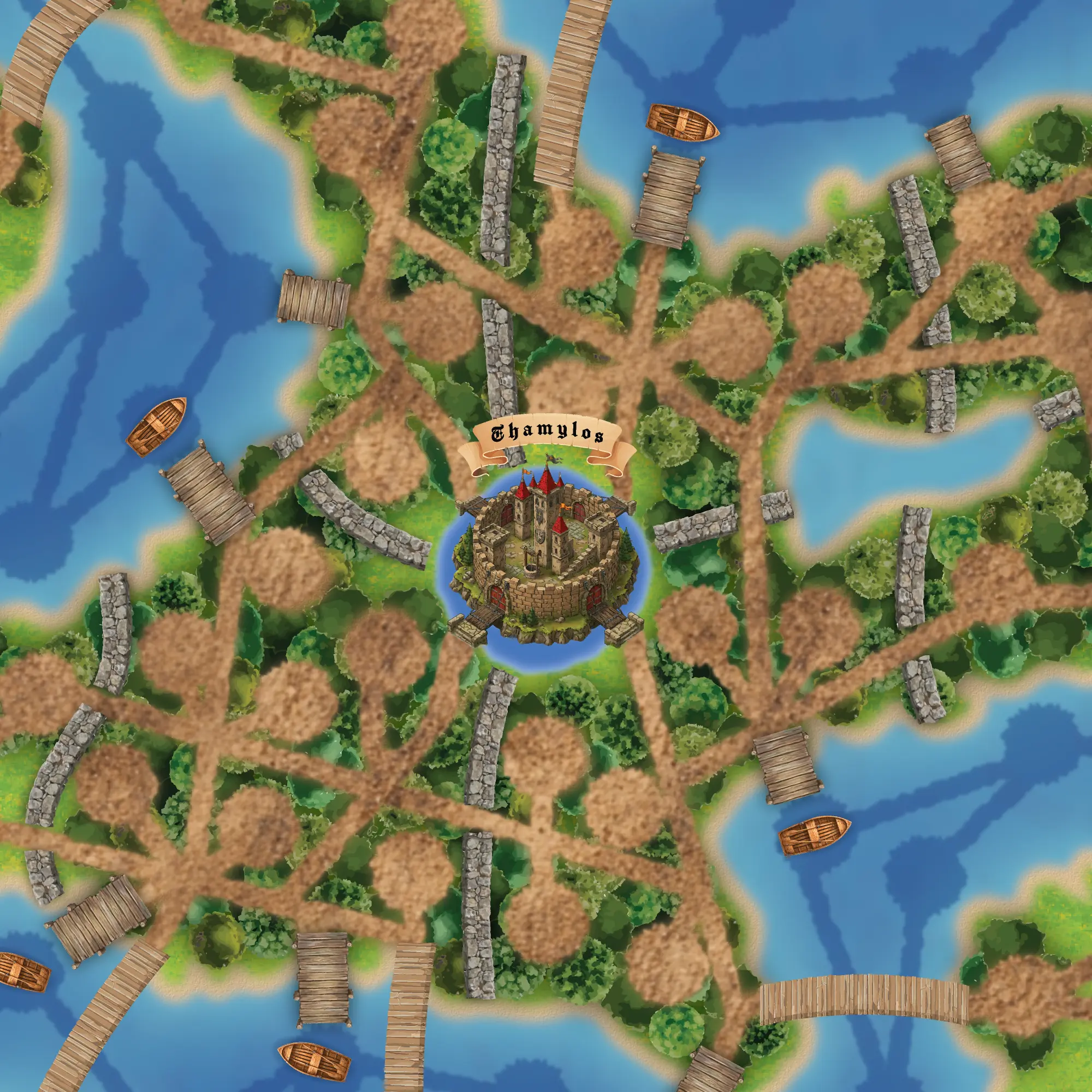
Thamylos is set in a crafted island world of forests, meadows, waterways and connected landscapes. Paths, bridges, shores and the central castle give the board a clear spatial structure and bring its landscapes together as one game world. Rather than an abstract geometric playing field, it is a designed island world for players to explore.
Forests, meadows and water create varied landscapes and give the island world its distinctive character.
Paths, shores and bridges connect the different areas. Their routes make the structure of the island world visible.
Castle Thamylos stands at the centre of the island world. It anchors the landscape both visually and spatially.
Forests, meadows, water and paths come together in one connected island world.
Objectives, pieces and routes
Find Diamonds, open routes, outmanoeuvre opponents and reach the most valuable Treasure Chests.
In the island world of Thamylos, players move Runners and Knights to transport Diamonds and earn as many Talers as possible. It is not simply a race to move ahead: success depends on positioning pieces carefully, using routes over land and water, and anticipating the options available to other players.
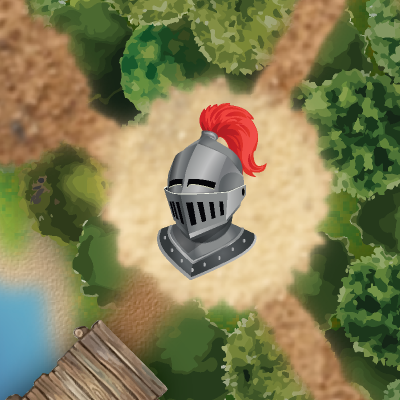
Runners carry Diamonds to their destinations. Only Runners can transport Diamonds. They move across the island and can pass Diamonds between one another.
Knights provide strength and protection. Runners can be promoted to Knights on the Knight Space. Knights are stronger in combat and can guard Diamonds.
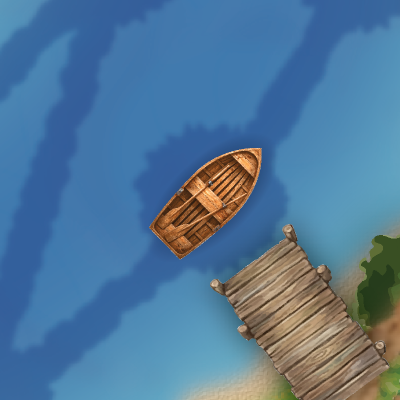
Water opens up new routes. The shared Boats allow Runners and Knights to travel across the water. Their positions change during play, making them a strategic factor in their own right.
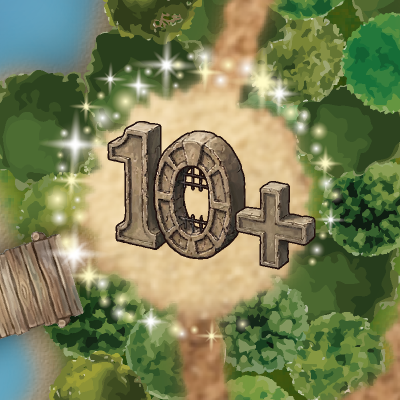
Magic Spaces change what is possible. Occupying a Magic Space can provide special advantages, such as additional movement options or influence over a Boat's position.
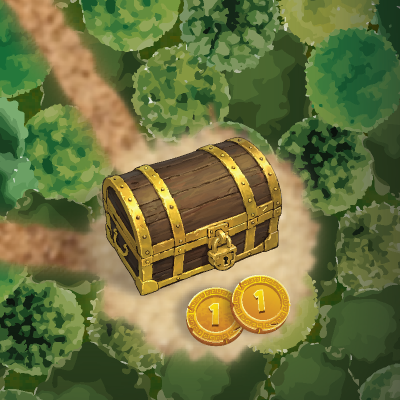
Transporting Diamonds is the ultimate objective. Delivering a Diamond to a Treasure Chest earns Talers. The Treasure Chests have different values.
The game ends as soon as the seventh of the eight Diamonds is placed in a Treasure Chest. The player with the most Talers then wins.
Many strategies can lead to victory.
Decisions, not chance
No dice. No random cards. Decisions determine what is possible.
Thamylos is a strategy game without any element of chance. Rather than hoping for a lucky roll or a random card, players assess the position on the board and make use of the options available to them.
A turn is more than moving a single piece.
Normally, 10 Movement Points are available and can be distributed among a player's pieces. This creates many different ways to shape a turn.
The game can be considered on two levels.
Strategically, players consider the Areas: Which parts of the board matter? What opportunities do they open up? Where should forces be concentrated?
Tactically, the exact position of each piece matters: Which piece can respond to an attack with a Counter-Capture? How can a Runner stay safe from a Knight? Where can a Knight block a route?
Other players are part of every decision.
Pieces can be captured, Diamonds contested, Boats used and Magic Spaces fought over. When a piece is captured, the affected player may, under certain conditions, make an immediate Counter-Capture — even outside their turn.
Players do not all have to follow the same strategy.
Strategic priorities can include transporting Diamonds, expanding movement options, using Boats, promoting Runners to Knights, or focusing on defence and attack.
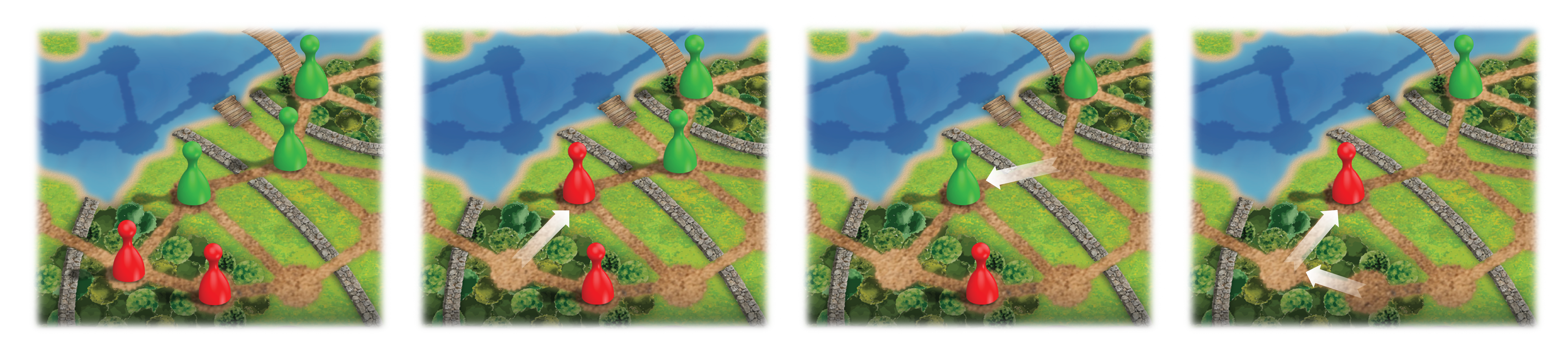
From idea to game
A game without random elements presents particular design challenges.
From the outset, the absence of chance was a deliberate principle in Thamylos. It also raised specific challenges: How can endless forward calculation be avoided? How can a game with many possibilities remain manageable? How can an advantage be prevented from simply growing ever larger?
The rules of Thamylos address these challenges. The following design decisions show how the game combines many possibilities, different strategic approaches and changing situations.
Many possibilities
The challenge: In a game without chance, future developments can in principle be calculated. Players may therefore try to analyse more and more moves in advance. This could lead to very long decision times.
The design response: Thamylos offers many possible actions within a turn. With up to 14 of a player's pieces on the board and numerous reachable positions for each piece, a turn can develop in many different ways. This abundance of options makes it harder to plan many moves ahead.
Two levels
The challenge: Many possibilities create freedom, but they can also make the game difficult to survey.
The design response: On the tactical level, the exact position of individual pieces matters: Which routes are reachable, who can transport a Diamond or respond to an attack? On the strategic level, the importance and control of Areas matter: Which areas are important, and what routes or objectives do they open up? The two levels complement each other: tactical moves put strategic decisions into action on the board.
Diamond delivery
The challenge: In a game without chance, an advantage can reinforce itself and keep growing. The game could quickly become boring for the other players.
The design response: Victory is achieved not by holding a strong position or capturing opposing pieces, but by transporting Diamonds to the Treasure Chests. A strong position has to be turned into successful Diamond deliveries, which weakens that position again and gives the other players an opportunity to strengthen theirs.
Return to the Castle
The challenge: When two players weaken each other, the others can benefit. If exchanges of captures permanently weakened the players involved, they would avoid fighting in games with more than two players. The game would become static, with no development.
The design response: Captured Runners return to Castle Thamylos. This causes a short-term loss of position and time, but the piece is not permanently eliminated and the player is not weakened for good.
Shared Boats
The challenge: Without chance, rigid move patterns can develop in a two-player game: both players move their pieces by the same distances in turn, repeatedly matching each other's positions. The same sequences of moves can then recur without significantly changing the game situation.
The design response: The Boats, which both players can use, break these patterns. When one player moves a Boat, it is no longer available to the other player at its original location. The other player cannot repeat the move and has to respond differently.
Approach and attack range
The challenge: In a game without chance, with pieces that have a limited movement range, a piece first has to get close to an opponent before it can capture them. During this approach, the opponent may attack first.
The design response: Depending on the situation, the problem can be addressed in several ways:
In the end, Talers determine the winner — not simply a strong position on the board.
Several strategic options
The challenge: A game without chance should not come down to one obviously optimal path. That path would be heavily contested, and the game would not develop.
The design response: Thamylos offers different ways to develop a strategy:
Players can also give up strength at the right moment to deliver Diamonds to the Treasure Chests quickly.
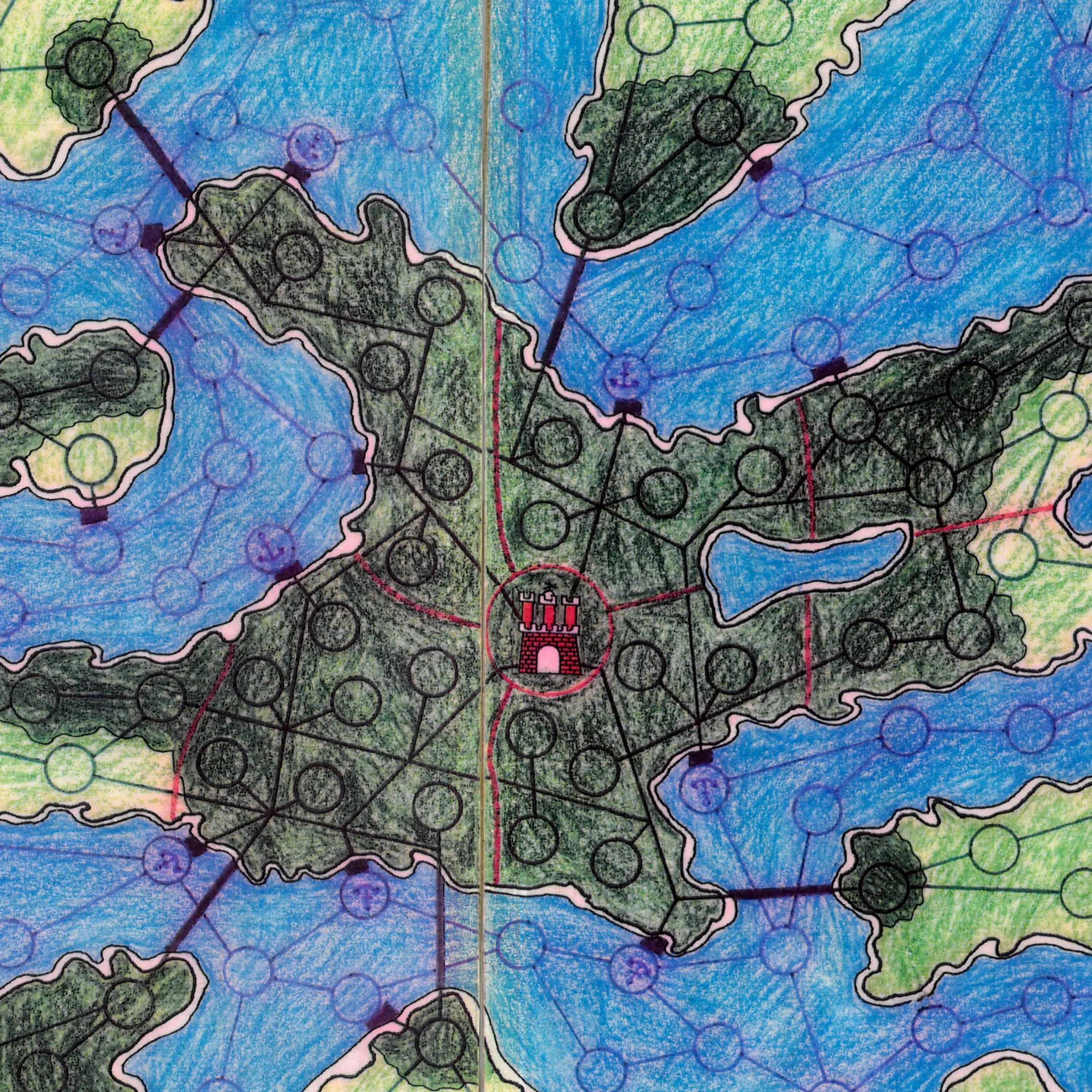
Developed together
Thamylos began more than 30 years ago as an idea shared by two school friends.
Horst Levien and Jürgen Waszkewitz developed the game together. Over many years, their original idea grew into the Thamylos we know today.
What began as a joint game project gradually became a fully developed strategy game with its own game world, its own pieces and a game system deliberately designed without random elements.
As the authors followed different paths in life, and with the technical and financial limitations of the time, the game slowly faded from memory. A school reunion then provided the spark it needed to be revived.
More than three decades after the original idea, a complete and mature game is now ready to be introduced to a wider audience.
Horst Levien & Jürgen Waszkewitz
What comes in the box
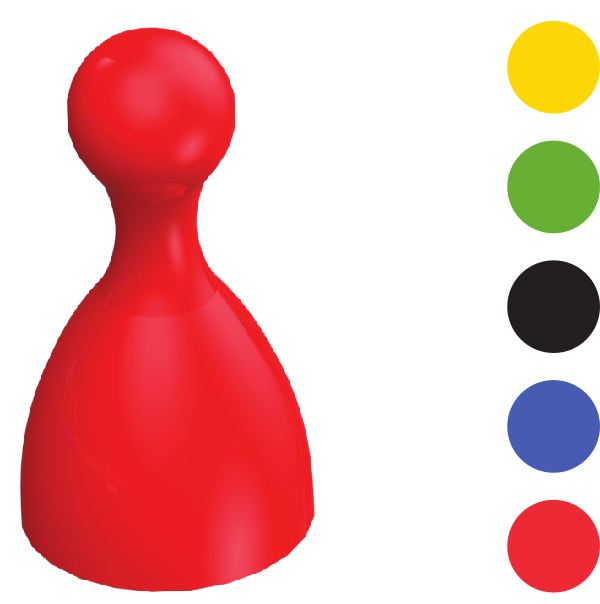
50 Runners in five colors: red, yellow, green, blue and black. Standard commercially available wooden Halma pawns with a 12 mm base diameter and a height of 24 mm.

20 Knights in the same five colors: red, yellow, green, blue and black. Standard commercially available wooden Halma pawns with a 15 mm base diameter and a height of 27 mm.

5 wooden discs in red, yellow, green, blue and black. Diameter: 16 mm; height: 4 mm.
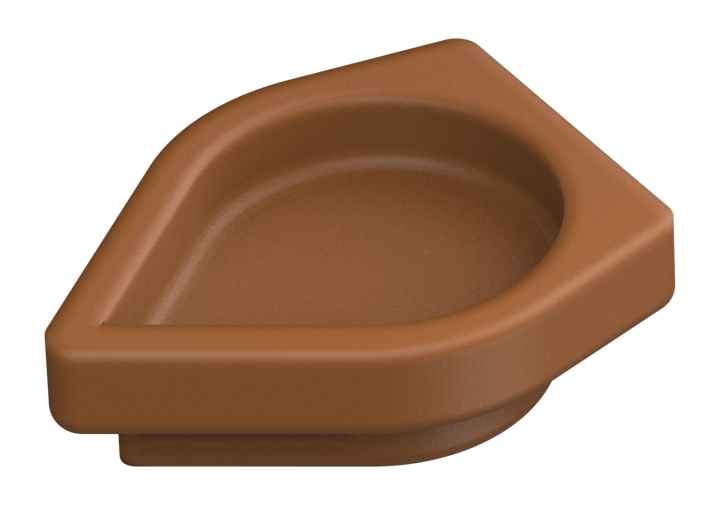
20 brown, custom-made plastic pieces. Dimensions: 17 mm × 7 mm × 22.1 mm.

8 white, custom-made plastic pieces. Dimensions: 17.3 mm × 7 mm × 20.9 mm.
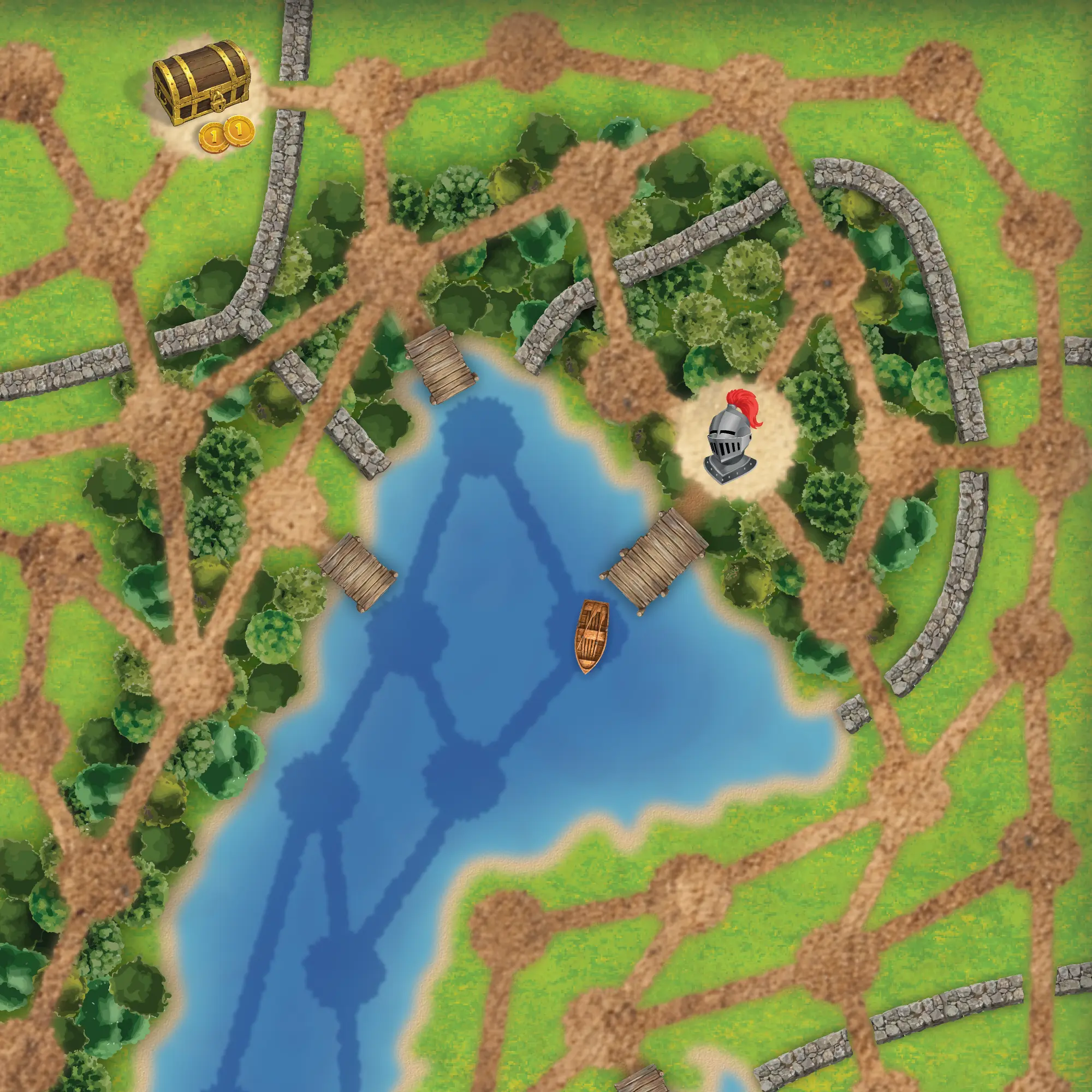
1 folding board. Dimensions: 56 × 56 cm; thickness: 2 mm.
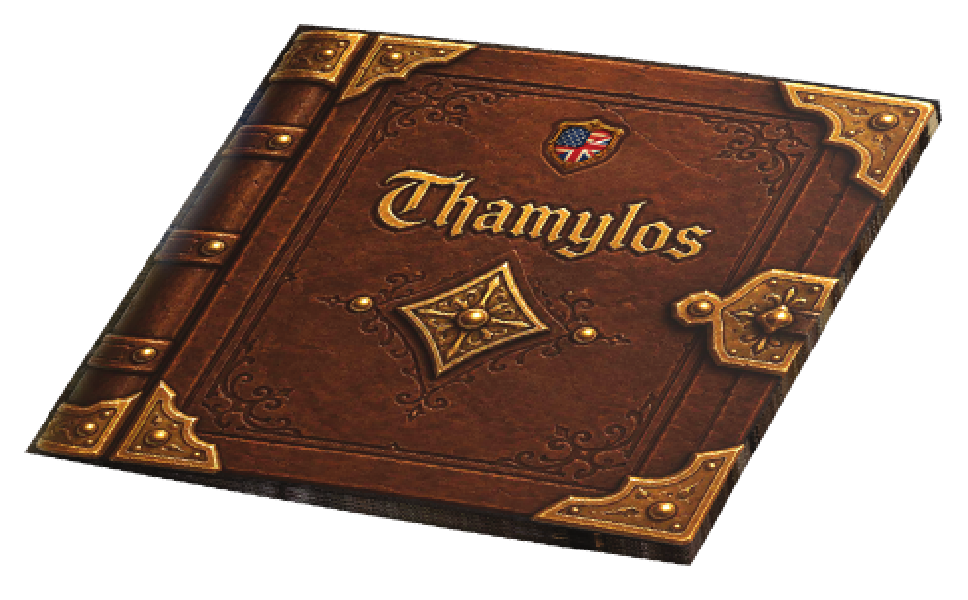
12 pages, 21 × 21 cm. German and English versions are available.
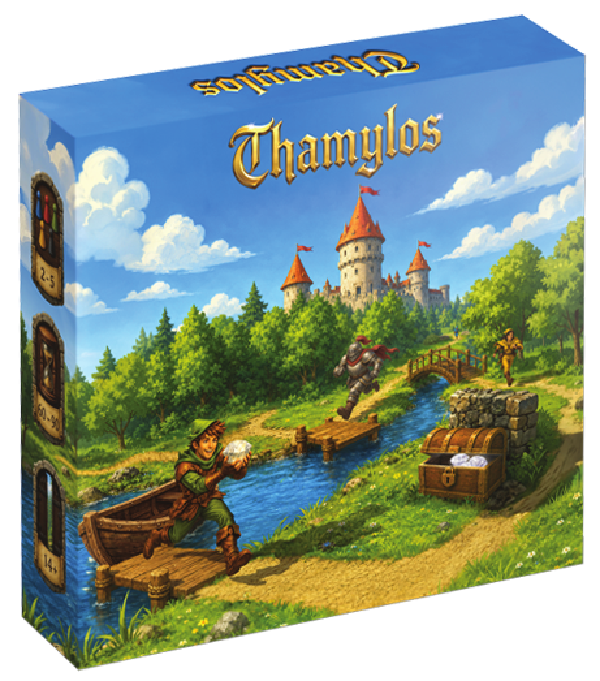
Two-piece box with dimensions of 29.5 × 29.5 × 7 cm, including a central compartment in the insert and a 15 × 20 cm cotton drawstring bag.
For publishers
Thamylos is a fully developed strategy game that is not yet commercially available.
We are looking for a board-game publisher to work with us on bringing Thamylos to market. The game is available for professional evaluation by interested publishers.
A small production run of complete games in German and English has been produced. The rulebooks are available in print and digital formats for professional evaluation.
The Runners and Knights are standard commercially available wooden Halma pawns in two sizes. Boats and Diamonds are custom-made plastic pieces, and STL files are available.
The production and print specifications can be discussed on request.
The authors hold the copyright in the game and the exclusive rights to use the artwork.
The authors registered the name Thamylos with EUIPO under registration number 019376540 in Class 28 for board games, games, table games and toys.
Get in touch
Interested in learning more about Thamylos or exploring a collaboration? We welcome enquiries.
For general enquiries, please email us.
General enquiries
info@thamylos.com+49 40 3346 5390For publishers
Interested publishers can request further information and materials.